
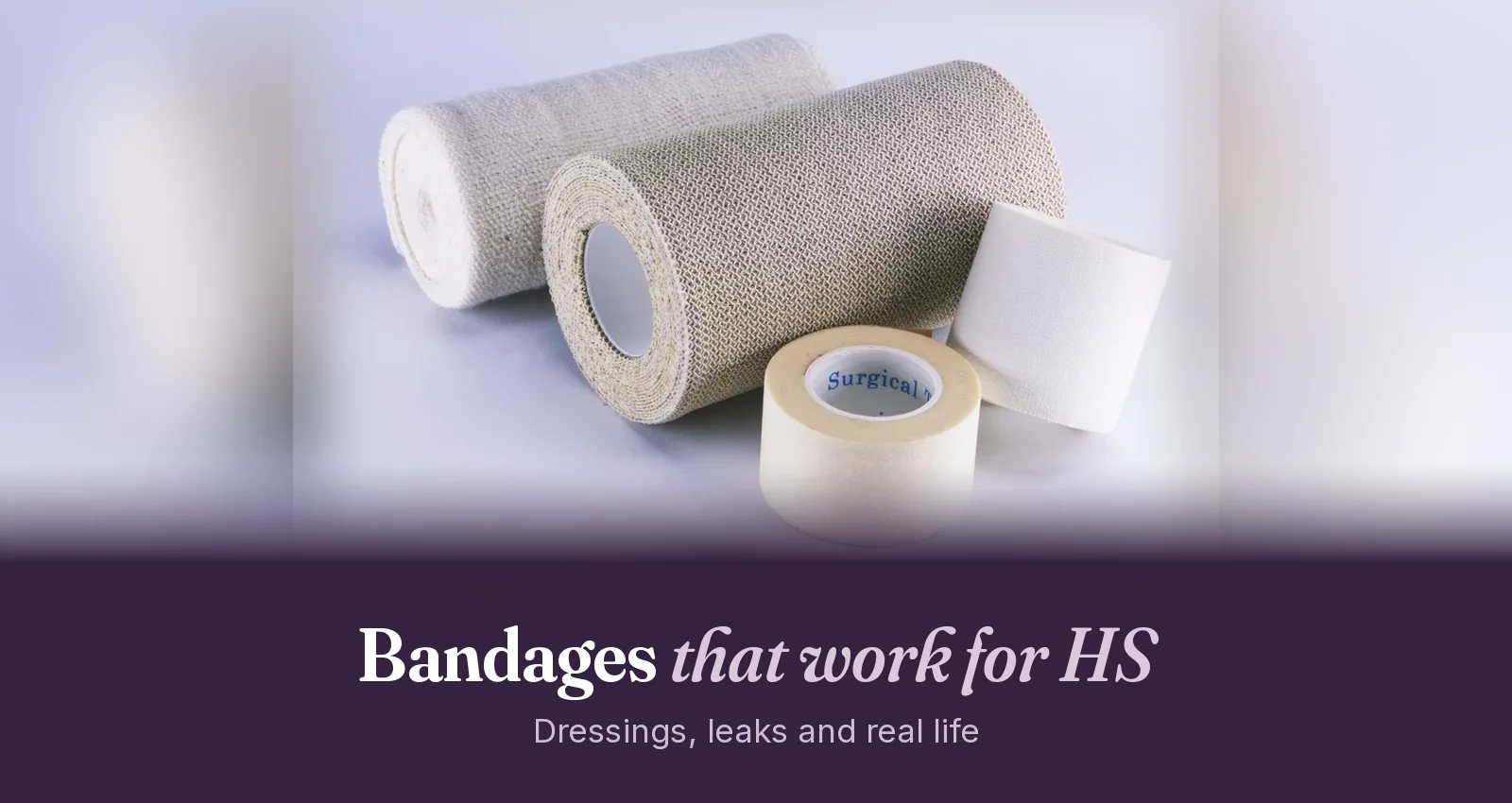
There is no single best bandage for hidradenitis suppurativa, and that is not me hedging: an international panel of HS and wound care experts concluded that an ideal HS dressing should hold in leakage and odour, absorb enough to protect the surrounding skin, stay comfortable in folds that move all day, and cost little, and that no product currently does all of that at once. So this is not a list with one winner. It is what the research and patient surveys say actually gets used, what I put on my own skin during the years my HS was at its worst, and how to keep a draining lesion from running your day at work. If your problem is the opposite one, a deep lump that refuses to open at all, I wrote about that separately in why an HS lump will not drain.
Why are HS lesions so hard to bandage?
Ordinary adhesive bandages were designed for a scraped knee: a flat, dry patch of skin that closes in days. HS gives you the opposite. Lesions sit in the armpit, groin, under the breast, on the inner thigh, exactly where skin folds, rubs and sweats. They can drain for days or weeks. And the skin around them is often inflamed or scarred, so peeling strong adhesive off it once or twice a day adds damage and pain of its own.
That combination is why the expert panel described HS wound care as a real unmet need, and why a pilot study of an adhesive-free, garment-based dressing system designed specifically for HS found such dramatic results in a small group: over 21 days, average dressing-related pain scores fell from 5.5 to 0.8 out of 10, and quality of life scores improved in every participant. Fifteen women is a tiny study, so treat the numbers with care, but the direction says something most of us know from experience: how a dressing attaches matters as much as what it absorbs.
Which dressings do dermatologists and patients actually use?
Two surveys published in 2023 give an honest picture, and it is much less glamorous than a product page.
When researchers asked dermatologists what they recommend to HS patients, the top answers were abdominal pads (80 percent), plain gauze (76 percent) and panty liners or menstrual pads (52 percent). When another survey asked 302 people with HS what they actually use at home, the list was almost the same: gauze, panty liners and menstrual pads, tissues, antiseptic dressings, abdominal pads and adhesive bandages.
Behind those humble answers there is a logic you can borrow. Reviews of HS wound care, including a dressing guide by Kazemi and colleagues, keep coming back to the same qualities:
- Absorbency. A draining lesion needs a dressing that soaks up fluid and holds it away from the skin. This is what makes abdominal pads and menstrual pads such popular workhorses: they are built to absorb, they are soft, and they are cheap. The Kazemi review organises dressings in tiers for exactly this reason, starting with accessible options before moving to specialised ones.
- A non-stick surface against the wound. Anything that dries into the wound turns the next dressing change into a small surgery. Non-adherent pads, or a non-stick contact layer under an absorbent pad, keep changes bearable.
- Gentle fixation. Tape on inflamed skin is a recurring complaint. Alternatives people use include tube-style retention bandages, soft gauze wrap, snug cotton clothing that holds a pad in place, or dressings with silicone rather than acrylic adhesive. The adhesive-free garment study above exists precisely because this problem is so common.
- Odour control. The expert panel lists containing odour among the core goals. A sealed, absorbent dressing changed often enough does most of that work. Hydrocolloid dressings, thin sheets that turn fluid into gel, can also help contain odour on lesions with low to moderate drainage, though they are not suitable for every wound and the adhesive border irritates some skin, so they are worth asking a clinician about rather than guessing.
- Cost you can sustain. The most technically advanced option in the Kazemi review, silver-impregnated foam, is described as closest to ideal and also expensive and hard to access. A dressing you can afford to change twice a day beats a perfect one you ration.
What did I actually use on my own skin?
My worst years taught me this subject the hard way, and the most intense lesson came after surgery. A surgeon who treated several of my cysts and abscesses opened them with the smallest possible laser incision, drained them, and packed the wound with gauze moistened with povidone iodine so it could keep draining while it healed. I have told the full story of those years in my story, but the practical part is this: that packed dressing had to be replaced every single day, and I could not do it alone. I needed another person's help, every day, until the wound closed. That was the care prescribed in my case, not a template for yours, and wound packing is not used for every abscess. But it permanently changed how I judge dressings.
Because here is the other thing I remember: the dressing was in a visible spot, and I hid it under my beard. Anyone who has walked into a meeting with a bulky pad taped inside their armpit or groin knows that a dressing is never just a medical object. It has to survive your actual life, your clothes, your commute, the way your arm swings. A dressing that is clinically fine but keeps peeling off in your waistband is not fine.
So my personal rules became simple. Something absorbent enough that I was not checking it every hour. Nothing stuck directly to broken or inflamed skin. Changed whenever it became wet, because a soaked pad against skin causes its own problems. And boringly consistent hygiene around it: washed hands, clean towels, clean clothes. None of this cured anything, and that is not its job. It bought me comfort, dignity and fewer setbacks while the bigger work on my health happened elsewhere. That bigger work, the elimination and reintroduction approach that eventually got me to remission, is the story I tell in my book.
How do you handle a draining flare at work?
Ask people with HS what breaks them and it is rarely the pathology. It is the Tuesday morning when a lesion opens an hour into a shift and there are seven hours to go. Threads about exactly this fill HS communities, and the practical wisdom in them lines up with what the surveys show people use. A small kit in a bag or a desk drawer changes the day:
- two or three spare pads or dressings, plus whatever holds them in place for you
- a small pack of wipes or saline for cleaning your hands and the skin around the lesion before you re-dress it
- a zip bag for the used dressing, because hunting for a discreet way to bin it is its own stress
- a spare underlayer, dark or patterned clothing on flare days, and a light jacket or cardigan that can cover a leak you cannot deal with immediately
None of this is medical treatment. It is logistics, and logistics is what gets you to the end of the shift with your calm intact. If flares are draining through dressings at work regularly, that is also information worth bringing to your dermatologist, because a lesion that persistently drains may need more than absorbent pads, and there are procedures and treatments designed for exactly that situation.
How do you protect the skin around a draining lesion?
The skin around an HS wound takes constant punishment from moisture, friction and adhesives, and protecting it is a core goal in the expert panel's recommendations, which stress absorbing exudate to prevent maceration, the soggy, white, fragile state skin gets when it stays wet too long.
Three habits do most of the work. Change dressings whenever they become wet or soiled rather than on a fixed schedule. Keep strong adhesive off the most irritated skin, using the gentler fixation options above. And consider a barrier product on the surrounding skin: in the dermatologist survey, 28 percent recommended zinc oxide cream, which forms a simple protective layer between skin and moisture. If the skin around your lesions is persistently raw or broken, a clinician or wound care nurse can suggest barrier films and dressing combinations matched to your skin, which beats trial and error on skin that is already struggling.
When is a draining wound a reason to call a doctor?
Most HS drainage is the condition doing what it unfortunately does, but not all of it. The American Academy of Dermatology advises telling your dermatologist about any wound that fails to heal, reopens after healing, or becomes more painful. On top of that, the general signs of a spreading infection deserve prompt attention rather than a better bandage: fever, rapidly increasing pain, spreading redness or warmth around the wound, or feeling generally unwell.
The same applies if you find yourself needing more and more absorbency over weeks. A dressing strategy that keeps escalating is a signal about the lesion underneath, and options like deroofing or a change in medical treatment are conversations your dermatologist can only have if they know what your daily reality looks like.
What if dressings are getting too expensive?
This deserves its own section because the research says it is half the battle. In the patient survey above, nearly half of the 302 respondents said they could not afford the type and quantity of supplies they would ideally want, and a third were dissatisfied with their current wound care. The companion survey of dermatologists found only half of them were ordering insurance-covered wound care supplies for patients, and its authors point out that documenting wound characteristics and referring to wound care specialists can unlock partially or fully covered supplies.
The practical move: tell your dermatologist plainly that dressing costs are a burden, and ask whether your wounds can be documented so supplies are prescribed or covered, or whether a wound care referral makes sense. In the meantime, the survey data is quietly reassuring: the cheap options, gauze, abdominal pads, menstrual pads, are not the embarrassing compromise. They are what dermatologists recommend most.
I am a patient, not a doctor. Everything here is my experience plus published research, and wounds vary enormously, so talk to your dermatologist or a wound care professional about what fits your case.
FAQ
What is the best cheap dressing for a draining HS lesion? The surveys point to absorbent basics: abdominal pads, plain gauze and menstrual pads or panty liners are the options dermatologists recommend most and patients use most. Pair them with a non-stick layer against the wound and gentle fixation instead of strong tape.
Are menstrual pads really okay to use on HS wounds? They appear both in what patients report using and in what dermatologists recommend, because they are absorbent, soft and affordable. They are not sterile wound dressings, so many people place a sterile non-adherent pad against the wound itself with the pad as the absorbent layer over it, and a clinician can advise on your specific wound.
How often should I change the dressing on a draining lesion? The guidance I followed, and the principle repeated in wound care advice, is to change it whenever it becomes wet or soiled rather than on a fixed clock. A soaked dressing held against skin promotes maceration and irritation of the surrounding area.
Do hydrocolloid dressings work for HS? They can suit some lesions with low to moderate drainage, and their gel-forming action can help contain odour. They should not go over heavily draining, deep or infected wounds, and the adhesive irritates some people, so they are a good question for your dermatologist or wound care nurse rather than a default.
Why does my bandage keep falling off my armpit or groin? Because those areas flex and sweat constantly, which defeats most adhesives, and HS skin often cannot tolerate stronger glue. Tube bandages, soft wraps, snug cotton layers and purpose-built adhesive-free garment systems all exist to solve exactly this, and the early research on the garment approach showed large reductions in dressing-related pain.
Sources
- Chopra D, Anand N, Brito S, et al. Wound care for patients with hidradenitis suppurativa: recommendations of an international panel of experts. Journal of the American Academy of Dermatology, 2023 (PubMed)
- Poondru S, Scott K, Riley JM. Wound care counseling of patients with hidradenitis suppurativa: perspectives of dermatologists. International Journal of Women's Dermatology, 2023 (PMC)
- Poondru S, Scott K, Riley JM. Patient perspectives of wound care management in hidradenitis suppurativa. Archives of Dermatological Research, 2023 (PubMed)
- Kazemi A, Carnaggio K, Clark M, Shephard C, Okoye GA. Optimal wound care management in hidradenitis suppurativa. Journal of Dermatological Treatment, 2018 (PubMed)
- Moloney S, Fitzgerald D, Roshan D, Gethin G. Impact of hidradenitis suppurativa-specific wound dressing system on patient quality of life and dressing-related pain: pilot study. Journal of Wound Care, 2022 (PubMed)
- American Academy of Dermatology. Hidradenitis suppurativa: self-care.
Reader comments (0)