
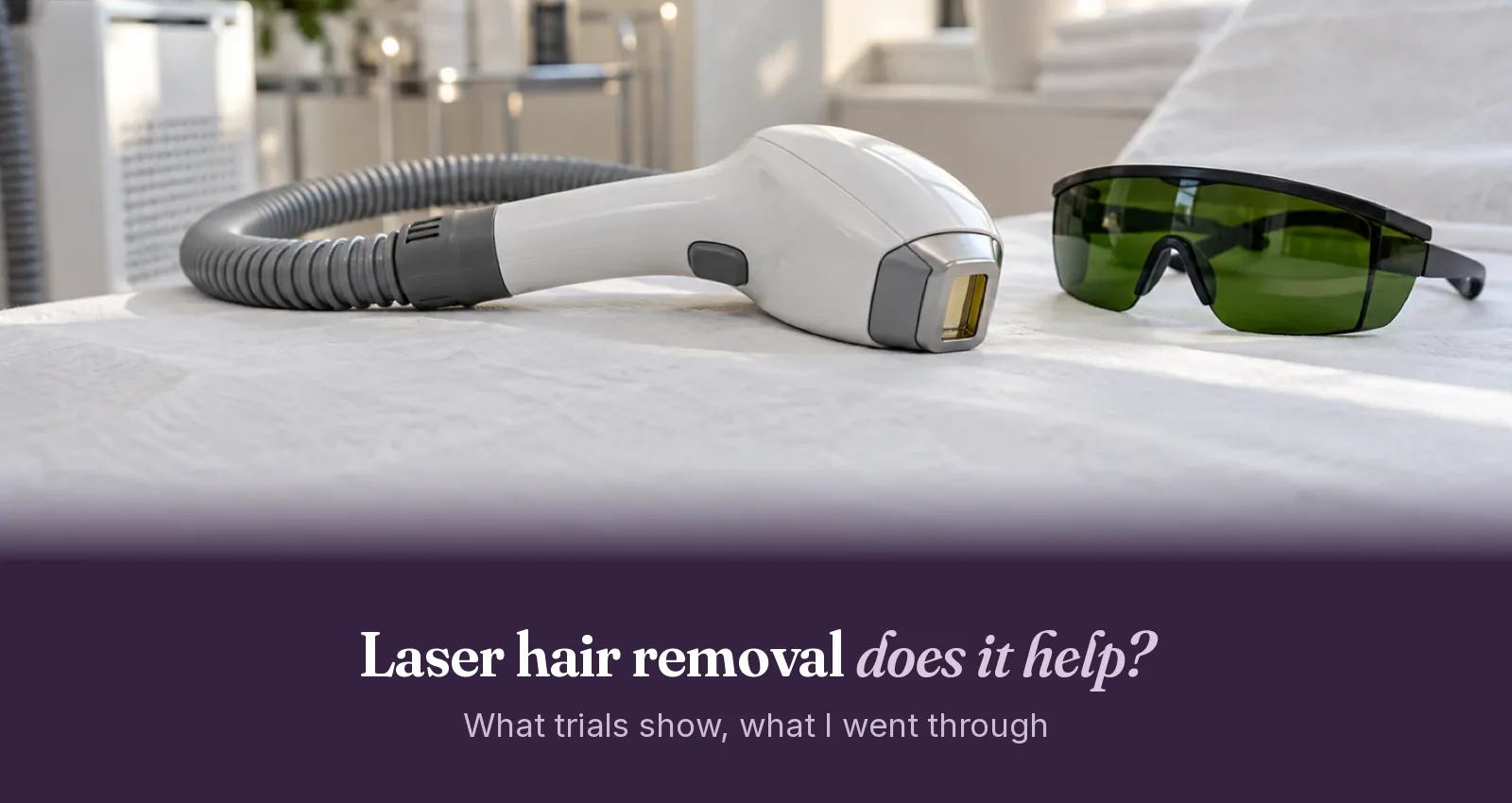
Laser hair removal is one of the few procedures for hidradenitis suppurativa that has actual randomized controlled trial support behind it. In studies, areas treated with hair removal lasers developed significantly fewer inflammatory lesions than untreated areas, with reductions typically between 50 and 75 percent, and the North American guidelines recommend the Nd:YAG laser for the disease. It is not a cure, nothing is with HS, and it does not work for everyone or every area. But I spent more than a year doing Nd:YAG sessions on my own affected areas, so this is one of the rare topics where I can give you both sides properly: what the trials measured, and what it actually feels like to sit through session after session while your HS is still deciding whether to cooperate.
Why would removing hair help a disease like HS?
Because HS does not start in the sweat glands, and it does not start with hygiene. Current research describes hidradenitis suppurativa as a chronic inflammatory disease of the hair follicle: the follicle becomes occluded, ruptures, and spills its contents into the surrounding skin, which sets off the inflammation, the nodules and the tunnels we know too well. If the follicle is where the fire starts, a laser that destroys or substantially weakens follicles removes fuel from the fire in that specific area.
That is the logic the studies test. A hair removal laser, such as the long-pulsed Nd:YAG or the alexandrite, delivers energy that is absorbed by the pigment in the hair shaft and follicle, damaging the follicular unit itself. A 2024 systematic review in the Journal of Drugs in Dermatology described the mechanism exactly this way: fewer active follicles in an HS-prone area means less occlusion, less bacterial buildup around follicles, and fewer new lesions getting started.
What does the research say about laser hair removal for HS?
More than you might expect for a treatment that most people still think of as cosmetic.
The classic study is a randomized controlled trial by Tierney and colleagues, published in Dermatologic Surgery in 2009. Twenty-two people with Hurley stage II or III disease had one side of the body treated with monthly Nd:YAG laser sessions plus a topical regimen, while the other side received the topical regimen alone. After three months, HS severity on the laser-treated side had dropped by 65.3 percent, with the strongest response in the groin. The untreated side barely moved.
Fifteen years later the result still holds up with a different laser. In a 2024 randomized controlled trial in JAAD International, patients received four monthly sessions of 755-nm alexandrite laser on one side of the body, with the opposite side as the control. At week 24, three quarters of treated sites reached the trial's definition of clinical response, compared with a third of untreated sites. The authors concluded the laser was safe and effective both in calming existing lesions and in keeping new ones from erupting in the treated areas.
The 2024 systematic review I mentioned above pooled 10 studies with 235 patients across laser hair removal and intense pulsed light, and found that every included study reported significant reductions in inflammatory lesions, mostly in the 50 to 75 percent range. The honest caveats: the studies are small, the scales they use are inconsistent, and how long the benefit lasts varies from study to study.
This is why the official guidance is positive but measured. The North American clinical management guidelines for HS, from the United States and Canadian Hidradenitis Suppurativa Foundations, recommend the Nd:YAG laser for Hurley stage II and III disease on the basis of trial and case series data, and support it for Hurley stage I by expert consensus. Not many HS treatments outside of medication carry that kind of recommendation.
What was more than a year of laser sessions actually like?
My laser story did not start as a success story. A dermatologist recommended laser hair removal during one of my worst stretches, when new abscesses were showing up in my armpits, groin and buttocks, and he even picked my bridging antibiotic partly because it did not cause photosensitivity and could sit alongside the laser sessions. That detail stayed with me: the treatments you are already on can interact with a laser plan, which is one more reason this belongs in a dermatologist's hands rather than only a cosmetic technician's.
The early sessions were not glamorous. Each one lasted around half an hour at first, and honestly, they hurt. The pain eased over the months as the follicles weakened, until later sessions felt like little more than mild discomfort, and they got shorter too. And my HS did not politely pause while I did them: a couple of months into the treatment I developed two new abscesses under one armpit, painful enough that they had to be opened. I kept going anyway.
Then things changed, although I want to be precise about why. Alongside the laser I overhauled how I ate, using an elimination and reintroduction approach, and added targeted supplementation under guidance. After I put those pieces together, I developed no new abscesses. That is my experience, not proof that laser, diet or supplements will do the same for anyone else, and I genuinely cannot tell you how much credit belongs to the laser alone. What I can say is that the laser steadily removed hair from the areas where my HS lived, and that with less hair there was simply less for the disease to work with, even if the occasional ingrown hair still showed up along the way. I tell the whole story, including the parts where nothing worked, in my book.
Who is a good candidate for laser hair removal with HS?
A few patterns come up consistently in the research and match what I was told in clinic.
- Earlier disease tends to respond better. The guidelines recommend Nd:YAG across Hurley stages, but laser hair removal makes the most mechanical sense while the disease is still centred on the follicles, before extensive tunnels and scarring take over. If you are not sure where you fit, I have explained the Hurley stages separately.
- Hair and skin contrast matters. Hair removal lasers target pigment, so they work best on dark, coarse hair. Very light, fine hair responds less well, whichever device is used.
- Darker skin needs the right device and the right hands. In the trial protocol cited by the North American guidelines, the Nd:YAG settings were adjusted by skin phototype, with gentler energy for Fitzpatrick types IV to VI. Deeper-penetrating lasers like the Nd:YAG are used across skin tones, but the operator's experience with your skin type is exactly the kind of thing to ask about before booking.
- Choose a medical setting that knows HS. This is my strongest personal opinion on the subject: an HS-experienced dermatology clinic, not a purely cosmetic chain. HS skin is not routine skin, flares can happen mid-course, and you want someone who understands the disease standing behind the laser.
What should you expect in practice?
Plan for a course, not an appointment. The trials mostly used three or four monthly sessions, and the guidelines note that additional treatments to further reduce follicular units may give a more lasting benefit. In my case, meaningful hair reduction took a longer series, with sessions spaced four to six weeks apart, and maintenance sessions can be needed afterwards because results are not guaranteed to be permanent.
Expect some irritation. Redness and swelling around the follicles right after a session is normal, and in HS skin the studies describe the possibility of a temporary increase in pain or drainage in treated areas. In my experience the discomfort was front-loaded: the first sessions were the hard ones.
And expect to talk about money, at least in the United States. Insurers commonly file laser hair removal under cosmetic procedures and decline to pay, even when it is being used for HS. A commentary in Dermatology Online Journal argued directly that laser hair reduction for HS warrants insurance coverage, precisely because HS is a painful chronic disease and the laser is used here as disease treatment, not aesthetics. Until payers catch up, documentation from your dermatologist is your best tool, and it is worth asking the clinic about medical pricing rather than cosmetic packages.
One last practical note from my own file: if you take medication, any medication, bring the full list to the dermatologist planning your laser course. Some drugs raise light sensitivity, mine was chosen specifically because it did not, and that conversation has to happen with someone who knows both your skin and your prescriptions.
FAQ
Can laser hair removal cure hidradenitis suppurativa? No. There is no cure for HS. In trials, laser hair removal reduced inflammatory lesions in treated areas by roughly 50 to 75 percent, which is meaningful, but the underlying disease tendency remains and other areas can still flare.
Can laser treatment make HS worse? The trials report temporary irritation, and in HS skin a short-lived increase in pain or drainage can happen after sessions. In my own course, new abscesses appeared early on and the treatment continued anyway. Lasting worsening has not been the pattern in the published laser studies, but any flare during treatment is something to show the dermatologist running your course.
How many sessions does it take to see a difference in HS? In the randomized trials, measurable improvement appeared after three to four monthly sessions. Fuller, longer-lasting hair reduction usually takes more, commonly eight to ten sessions spaced four to six weeks apart, plus occasional maintenance.
Does insurance cover laser hair removal for HS? In the US, often not, because it is typically classified as cosmetic. Coverage sometimes succeeds with detailed documentation from a dermatologist stating it is treatment for HS, and dermatologists have argued in the literature that it deserves routine coverage. It costs nothing to have your clinic submit it properly before you assume you must pay out of pocket.
Does it work on blond, red or gray hair? Hair removal lasers target pigment, so results on very light hair are weaker. If your hair in the affected areas is light, raise it honestly with the clinic before paying for a course.
Whatever you decide, decide it with a dermatologist who knows your case, your stage and your current treatments. Laser was one piece of my own path, and the right person to tell you whether it belongs in yours has your chart open in front of them.
Sources
- Tierney E, Mahmoud BH, Hexsel C, Ozog D, Hamzavi I. Randomized control trial for the treatment of hidradenitis suppurativa with a neodymium-doped yttrium aluminium garnet laser. Dermatologic Surgery, 2009 (PubMed)
- Sidhom S, Utz Petry S, Ward R, Daveluy S. Treatment of hidradenitis suppurativa with 755-nm alexandrite laser hair removal: a randomized controlled trial. JAAD International, 2024
- Kanwal A, et al. The Efficacy of Intense Pulsed Light and Laser Hair Removal in Hidradenitis Suppurativa Treatment. Journal of Drugs in Dermatology, 2024
- Alikhan A, et al. North American clinical management guidelines for hidradenitis suppurativa, Part I: diagnosis, evaluation, and the use of complementary and procedural management. Journal of the American Academy of Dermatology, 2019 (PMC)
- Laser hair reduction for hidradenitis suppurativa warrants insurance coverage. Dermatology Online Journal (eScholarship)
Reader comments (0)