
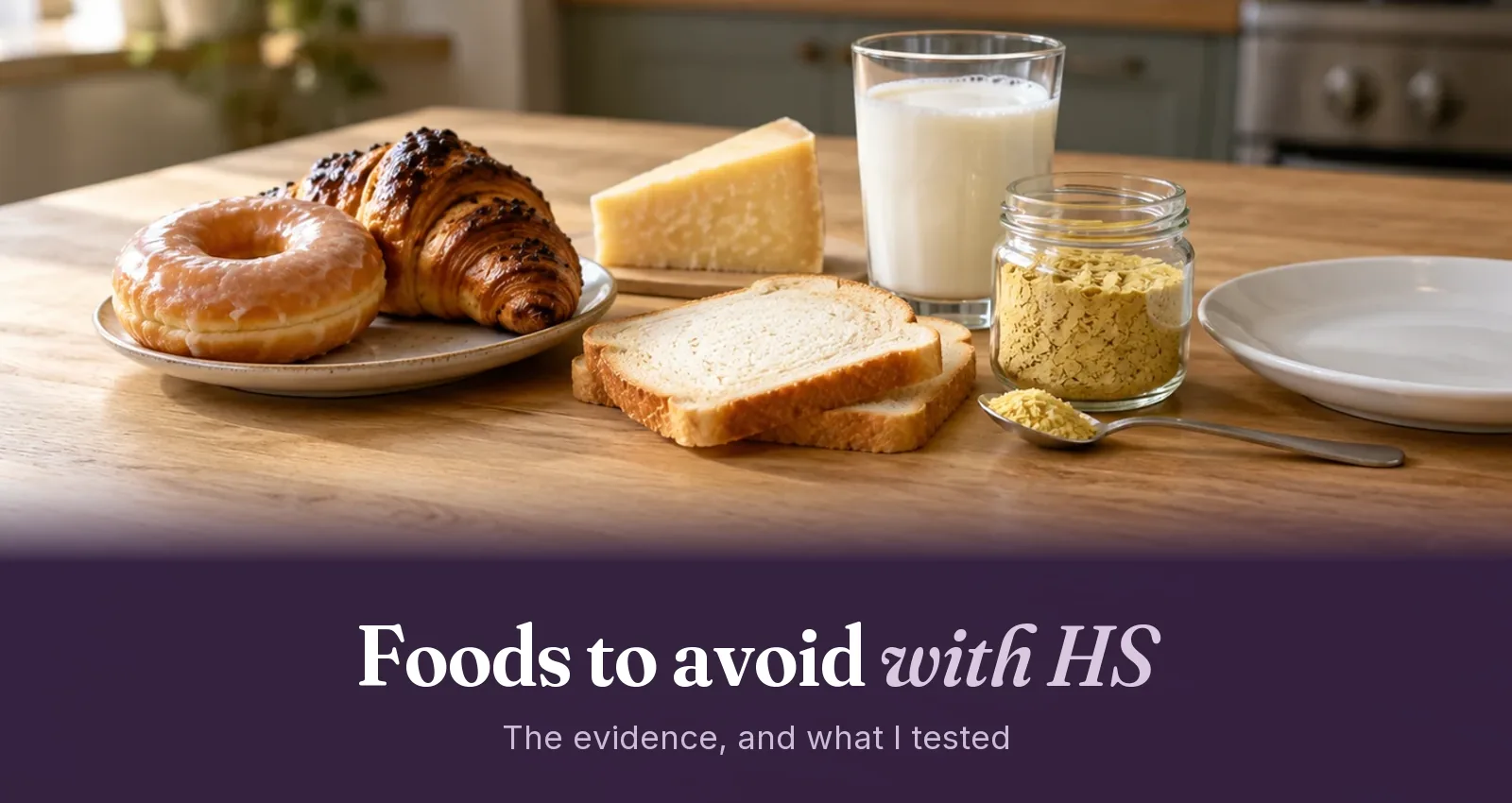
There is no food list that is proven to make hidradenitis suppurativa better for everyone, and no diet is a cure. But if you look at what people with HS actually report, and at the handful of small studies we have, the same suspects keep showing up: sweets and added sugar, refined carbohydrates like white bread and pasta, dairy, high fat processed food, and brewer's yeast, which also means beer. I have HS, and I spent years testing foods on my own skin through elimination and reintroduction. In this article I go through the usual suspects one by one: what the evidence actually says about each, and what happened in my case.
Which foods do people with HS report as triggers most often?
The clearest picture of patient experience comes from a survey of 770 people with HS recruited through Facebook support groups and HS specialty clinics (Fernandez and colleagues, Dermatologic Therapy, 2020). Among the respondents who had noticed that food affected their skin, the most commonly reported flare triggers were:
- Sweets (67.9%)
- Bread, pasta and rice (51.1%)
- Dairy (50.6%)
- High fat foods (44.2%)
On the other side, vegetables (78.7%), fruit (56.2%), chicken (51.7%) and fish (42.7%) were the foods people most often said helped them.
Two honest caveats before you rearrange your kitchen. This is self reported, so it cannot show cause and effect. And only about a third of respondents identified any exacerbating food at all, which already tells you something important: food reactions in HS are real for many of us, but they are far from universal.
What does the evidence say about each food?
Brewer's yeast, and the beer that carries it
Brewer's yeast is the single most tested food in HS research, and the results are striking for such small studies. In 2013, Cannistrà and colleagues followed twelve post surgery patients who all had an immune reaction to brewer's yeast and wheat on antibody testing. On a yeast free diet for twelve months their symptoms stabilised and lesions regressed, and lesions came back when they went back to yeast or had a beer.
A follow up study in 2020 (Aboud and colleagues, Surgery) looked at 37 patients on a yeast exclusion diet: 70% reported improvement, and 87% saw lesions return within a week of putting yeast back on the plate.
The caveats matter here. These were small groups, selected patients who had already had surgery, and in the first study everyone had tested positive for yeast antibodies, so the results may not transfer to you. Still, among food triggers this is the strongest signal we have, and brewer's yeast hides in more places than beer: bread spreads like Marmite, some stock cubes, and many supplements.
Dairy
Dairy has the second most cited data. In an uncontrolled series reported by Danby in the Journal of the American Academy of Dermatology, 2015, 83% of 47 patients who went dairy free showed clinical improvement. A later German study cited in a 2023 review in Dermatology and Therapy found that only 7 of 40 patients improved considerably on a low dairy, low carbohydrate diet. So the evidence is mixed and weak, with no control groups anywhere. What keeps dairy on the suspect list is that it also tops the patient surveys, and researchers point to milk proteins like casein and whey, and to the hormonal content of milk, as plausible mechanisms. Plausible is not proven.
Sugar and refined carbohydrates
Nobody has run an elimination trial on sugar in HS, but the proposed mechanism is well described: simple carbohydrates spike insulin and IGF-1, which activate signalling pathways (mTOR and androgen receptors) involved in follicular occlusion and inflammation, the core machinery of HS (Shen and colleagues, Dermatology and Therapy, 2023). Sweets were also the number one reported trigger in the patient survey above, at 67.9%. I have written in more detail about insulin, sugar and HS, because in my own case cutting added sugar was one of the changes I have never walked back.
Grains, legumes and nightshades
Here the evidence gets thin: there are no HS specific studies on grains, legumes or nightshades like tomatoes, peppers and aubergines. These groups come from elimination frameworks such as the Autoimmune Protocol, which removes them for a period precisely because some people seem to react to them, and then tests each one through reintroduction. The honest way to treat them is as questions, not verdicts. They belong on a personal testing list, not on a universal avoid list.
What did I actually remove, and what came back?
My own approach was an AIP style elimination in the Paleo tradition. For a period I removed grains, legumes, dairy and nightshades, including tomatoes, peppers, aubergines and nightshade derived spices, and then reintroduced foods one at a time, watching my skin at every step. With dairy I paid particular attention to the less obvious forms: processed cheeses, fat free milk, and ingredient labels that say casein or caseinate. I tell the full story, phase by phase, in my book.
The part I am proudest of is not what I removed. It is what I brought back. Over the years, with patient one at a time testing, I have welcomed dark chocolate, nuts and peeled potatoes back into my life. If you have never done a real elimination phase, that list may sound modest. If you have, you know every one of those foods feels like a celebration.
And yes, there have been slip ups. In especially settled periods I have occasionally eaten gluten or dairy without noticing any reaction. I want to be careful with that sentence: these were rare exceptions in a long maintained routine, not a green light, and they do not mean my triggers disappeared. My skin went into remission and has stayed manageable for years, and I treat that as something to maintain, not a finish line.
How do you find your own trigger foods?
Everything above points the same way: reactions are individual, so the useful question is not "what should everyone avoid" but "how do I find what I react to". What worked for me is a simple, boring, repeatable process:
- Fix the baseline first. Cutting ultra processed food and added sugar is low risk and makes the next steps readable. For some people this alone calms things down.
- Remove one group at a time, for a few weeks. If you cut five things at once and improve, you have no idea which one mattered.
- Keep a plain diary. Flares, pain, new lesions, dates. Memory lies; a notebook does not.
- Reintroduce, always. Bring the food back and watch what happens. Reintroduction is not a footnote, it is the whole point: it is the difference between finding your triggers and just shrinking your diet forever. I describe how I paced it in the reintroduction phase of my protocol.
Two guardrails. Ideally do this with a dietitian or clinician alongside, especially if you are on medication, pregnant or managing another condition. And if food starts to feel like an obsession, that is a red flag: step back and get support. The goal is fewer flares and a normal life, not an ever shrinking list of safe foods.
Is there one list of foods everyone with HS should avoid?
No, and anyone who claims otherwise is ahead of the evidence. The American Academy of Dermatology is blunt about it: the research is limited, and studies conflict. Even for the Mediterranean diet, one study found higher adherence associated with lower disease activity (Lorite-Fuentes and colleagues, Nutrients, 2022) while another found no association with severity. The 2023 review I cited above concludes that no concrete dietary guidelines for HS exist yet.
So the honest summary is this. Sweets, refined carbs, dairy, high fat processed food and brewer's yeast are the best supported suspects, worth testing in your own case. Vegetables, fruit and fish are the foods patients most often report as helpful. Diet is a support alongside your medical treatment, never a replacement for it. I am a patient, not a doctor, so before any big change, talk it through with your dermatologist and ideally a dietitian who knows your case.
FAQ
Can avoiding these foods cure hidradenitis suppurativa? No. There is no cure for HS, dietary or otherwise. What the small studies and surveys suggest is that identifying your personal trigger foods may reduce flares for some people. That is a real and worthwhile goal, and a very different claim.
Is beer bad for hidradenitis suppurativa? Beer carries brewer's yeast, which is the most studied food trigger in HS: in two small studies, patients who had tested positive for yeast antibodies improved while avoiding it and most flared again when it returned. That does not make beer a problem for every person with HS, but if you are testing yeast, beer belongs in the test.
Do I have to give up dairy forever? Not necessarily. The point of elimination is to earn a reliable answer, not to ban foods for life. In my own case, after years of a stable routine, I have very occasionally had dairy without noticing a reaction. Reintroduction, done one food at a time, is what tells you where you actually stand.
How long should an elimination phase last? The yeast studies ran for months, and my own elimination lasted a few weeks per food group before reintroduction. There is no validated universal duration, which is one more reason to pace it with a dietitian or clinician rather than guessing alone.
Sources
- Fernandez JM et al. Alleviating and exacerbating foods in hidradenitis suppurativa. Dermatologic Therapy, 2020 (PubMed)
- Cannistrà C et al. New perspectives in the treatment of hidradenitis suppurativa: surgery and brewer's yeast-exclusion diet. Surgery, 2013 (PubMed)
- Aboud C et al. Treatment of hidradenitis suppurativa: surgery and yeast (Saccharomyces cerevisiae)-exclusion diet. Surgery, 2020 (PubMed)
- Danby FW. Diet in the prevention of hidradenitis suppurativa (acne inversa). Journal of the American Academy of Dermatology, 2015 (PubMed)
- Shen AS, Johnson JS, Kerns ML. Dietary Factors and Hidradenitis Suppurativa. Dermatology and Therapy, 2023 (PMC)
- Lorite-Fuentes I et al. Potential Benefits of the Mediterranean Diet and Physical Activity in Patients with Hidradenitis Suppurativa. Nutrients, 2022 (PubMed)
- American Academy of Dermatology. Is there a diet for hidradenitis suppurativa?
Reader comments (0)