
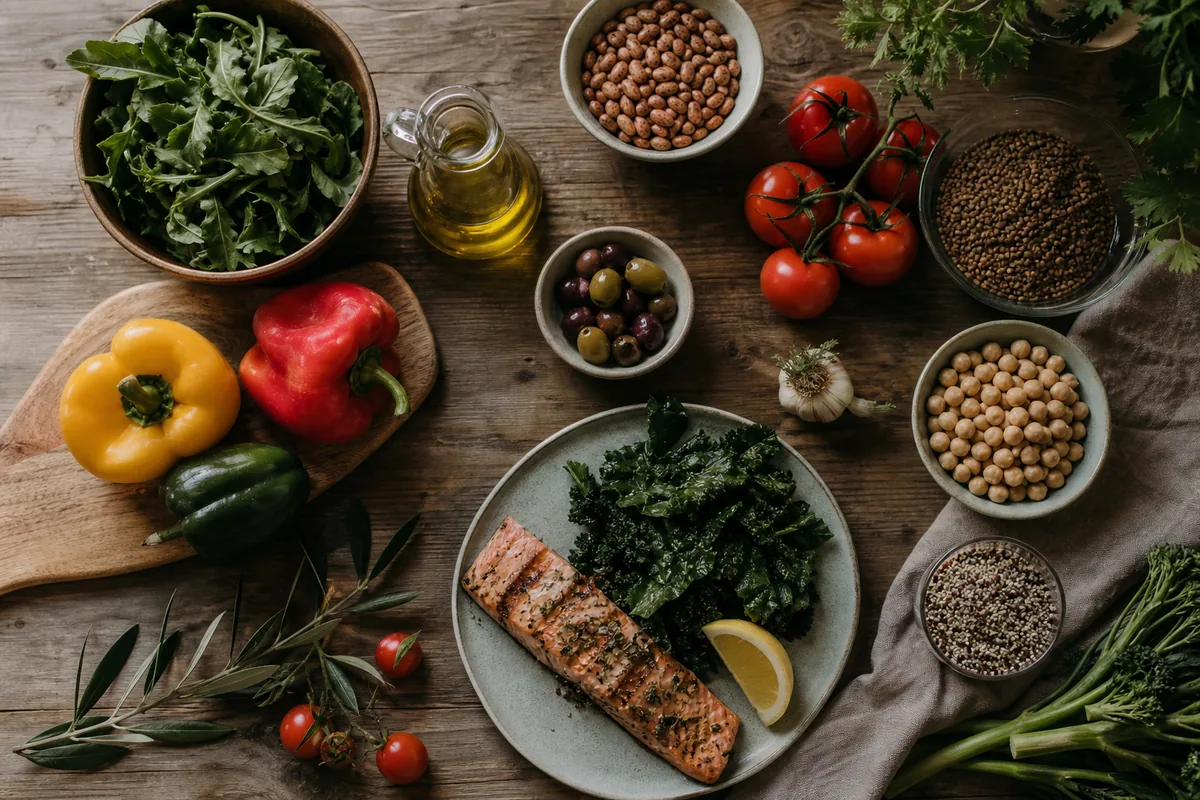
There is no cure for hidradenitis suppurativa (HS), and a Mediterranean-style diet is the eating pattern with the most HS research behind it so far. As a starting point it is reasonable and low-risk. But I want to be honest from the first line: in my own case I went further than the Mediterranean diet, because several of its staples, including grains, legumes, dairy and nightshades such as tomatoes, were exactly the foods I ended up testing and often removing. This is the evidence alongside my real experience, not a promise of results.
What does the research say about the Mediterranean diet and HS?
The evidence is still limited, but it is growing, and it is encouraging.
- A study in a Spanish population reported that higher adherence to a Mediterranean diet was associated with lower disease severity, less symptom intensity and a lower self-reported Hurley stage (HS Foundation summary).
- A 2024 cross-sectional study found that body composition and nutritional factors, including dietary glycemic index, were linked to HS severity (Kesik et al., *Nutrients*, PMC).
- The American Academy of Dermatology notes that in small studies weight loss lessened HS in people who were overweight or obese, and it suggests cutting highly processed foods (AAD).
These are associations from small, mostly cross-sectional studies. They cannot prove that a diet will improve your HS, and none of them point to a cure. In its traditional, varied form, built on vegetables, fish and olive oil rather than refined pasta and bread, the Mediterranean pattern is widely regarded as a potentially healthful way of eating. As a baseline, it is a sensible place to begin.
So why did I not simply follow the Mediterranean diet?
Because for me a healthy general pattern was not enough, and the Mediterranean diet keeps several food groups that I needed to question one by one.
The approach I actually followed is an elimination and reintroduction framework in the tradition of the Autoimmune Protocol (AIP), which grew out of the Paleo idea. Researchers such as Loren Cordain argued that some foods that became common more recently, in particular grains, legumes and dairy, may contribute to symptoms in susceptible people. Grains and legumes also contain compounds sometimes called antinutrients, including lectins, which is why these frameworks treat them as foods to test rather than assume.
That is the honest tension with the Mediterranean diet. It is built on whole grains, legumes, some dairy and nightshades like tomatoes, and those are exactly the groups I chose to remove for a while and then reintroduce carefully to see how my own body responded. I tell that full story, step by step, in the book. So I do not think of the Mediterranean diet as wrong. I think of it as a reasonable baseline that, in my case, I had to go beyond.
Which Mediterranean foods did I end up questioning?
Not because they are bad for everyone, but because they are the ones an elimination approach puts under the microscope:
- Grains (including whole grains), for their lectin and antinutrient content.
- Legumes, for the same reason.
- Dairy, high-fat dairy in particular, which many people with HS report as a trigger.
- Nightshades such as tomatoes, peppers and aubergines, which the Mediterranean kitchen uses heavily.
The point is not to fear these foods. It is that reactions in HS are individual, and the only way to know yours is to remove a group for a while and reintroduce it, rather than keeping everything simply because a named diet includes it.
How I would actually use this
If I were starting again, I would treat the Mediterranean pattern as step one and my own approach as step two:
- First, shift toward a whole-food, lower-sugar way of eating and cut the clearly processed stuff. For some people that alone helps, and it is low-risk.
- If that is not enough, test the groups above one at a time: remove one for a few weeks, keep a simple diary of flares, pain and new lesions, then reintroduce it and watch what happens. Reintroduction is not optional; it is how you avoid restricting your diet for no reason.
- Do not stop any prescribed treatment, and talk to your doctor before big changes, especially if you are pregnant, managing another condition or on medication.
If food ever starts to feel obsessive, that is a red flag to step back and get support. The goal is fewer flares and a normal life, not an ever-shrinking list of "safe" foods.
FAQ
Can the Mediterranean diet cure hidradenitis suppurativa? No. There is no known cure for HS. The evidence suggests a Mediterranean pattern may be associated with less severe disease for some people, which makes it a reasonable, low-risk baseline to test with your doctor.
Is the Mediterranean diet better than an elimination diet for HS? They answer different questions. The Mediterranean pattern is a sustainable general direction with some HS evidence. An elimination-and-reintroduction approach is a way to find your own triggers, and in my case it went further by questioning grains, legumes, dairy and nightshades that the Mediterranean diet keeps.
Do I have to give up grains, legumes and tomatoes? Not as a rule. They are simply the foods worth testing one at a time. Some people reintroduce them with no problem; others find a repeatable reaction. Only your own testing tells you.
Is any of this instead of medical treatment? No. Think of diet as something that may support your treatment, not replace it. Keep working with your dermatologist.
For the food-by-food picture (dairy, yeast, sugar, nightshades and the rest, each with its evidence level and sources), explore the complete HS diet and food-trigger guide.
Reader comments (0)